





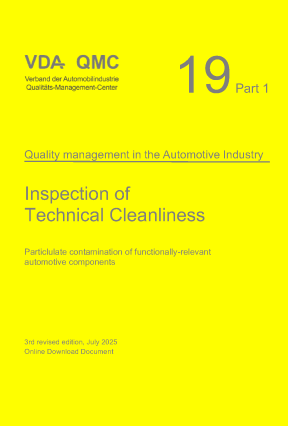
After nearly three years of development and multiple rounds of expert discussions, the yellow book of new VDA 19.1 English version has recently been published. This revision incorporates the experience and expertise of German VDA 19.1 working group experts and their respective companies, while also fully considering inputs and recommendations from the VDA 19.1 China Mirror Working Group.
Revision Background
Since the first VDA 19 edition was published in January 2004, it has gained widespread application and accumulated extensive experiences and knowledge. Particularly since the second edition of VDA 19.1 was published in 2015, the automotive industry has undergone a transition from combustion engines to electric vehicles as well as autonomous driving, and technical cleanliness is now stipulated as a ubiquitous quality characteristic in all new projects, along with corresponding specifications. Manufacturing process technologies have rapidly developed, and system component clearances have become smaller and smaller, making automotive systems and components increasingly sensitive to particle contamination. Consequently, the automotive industry demands increasingly strict control of technical cleanliness. This has generated new inspection demands on one hand, while also introducing many new inspection methods and devices on the other.
Revision Goals
This revision primarily focuses on meeting the demands of cleanliness testing, enabling broader application of new testing technologies and methods to better satisfy the requirements of technical cleanliness control. Specifically:
1Integrate new dry extraction methods as well as new analysis techniques.
Achieve easily comparable standard analyses while simultaneously allowing for the development of problem-adapted, free inspections within defined requirements.
More precisely describe the inspection of particles < 50 μm.
Develop an SEM/EDX standard analysis with uniform material classes.
Numerous optimizations and clarifications in the elaboration of inspection procedures and adaptation of starting parameters based on years of experience in cleanliness laboratories.
Major Changes
In the new version, the overall chapter structure of the standard remains unchanged. The basic inspection methods and procedures from the first and second editions that have proven effective in practice continue to be maintained. The main additions and changes include the following:
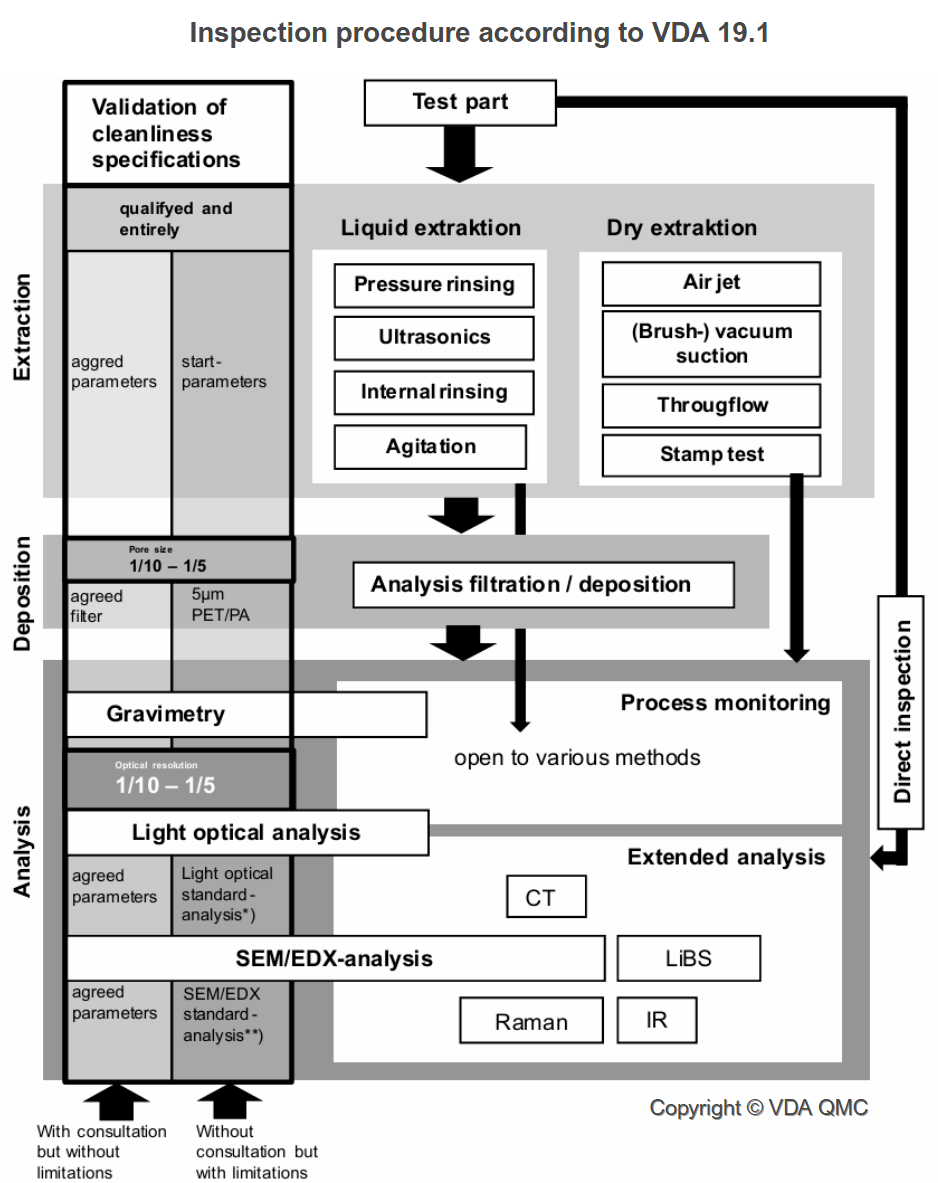
SEM/EDX classified as standard analysis with clearly defined unified parameter settings and material classification criteria.
Inspection methods applicable to specific issues, particularly for bright and low-contrast particles, allowing customer-supplier coordination for situation-specific agreements based on minimum requirements.
Clear requirements for filter and optical analysis instrument resolution selection for the inspection of particles smaller than 50μm.
Introduction of new extraction methods drawing from VDA 19.2: dry vacuum suction and stamping test.
Adjustment of start-up parameters for pressure rinsing and ultrasonic extraction methods.
Optimization of operational procedures for decline tests, routine inspections, and blank value tests to make processes clearer, simpler, and more feasible.
Further clarification of reaction plans when limit values were exceeded.
Explanation of key points for assessing measurement uncertainty in technical cleanliness inspection.
Download
The VDA 19.1 Yellow Book has now been uploaded to the VDA QMC website and is available for download via the following link. In addition, if you have suggestions for improvement, you can also download the feedback form on this page, fill it out, and submit it via the email address provided in the form.
Download URL:https://vda-qmc.de/en/publikationen-und-apps/gelbbaende/
The deadline for feedback is October 31, 2025. After the feedback collection phase, the Red Book is expected to be published by the end of 2025.
Press Contact | marketing @vdachina.com.cn